

E&R Publishers are proud to announce the release of More Human Than Human—What AI Reveals About Us
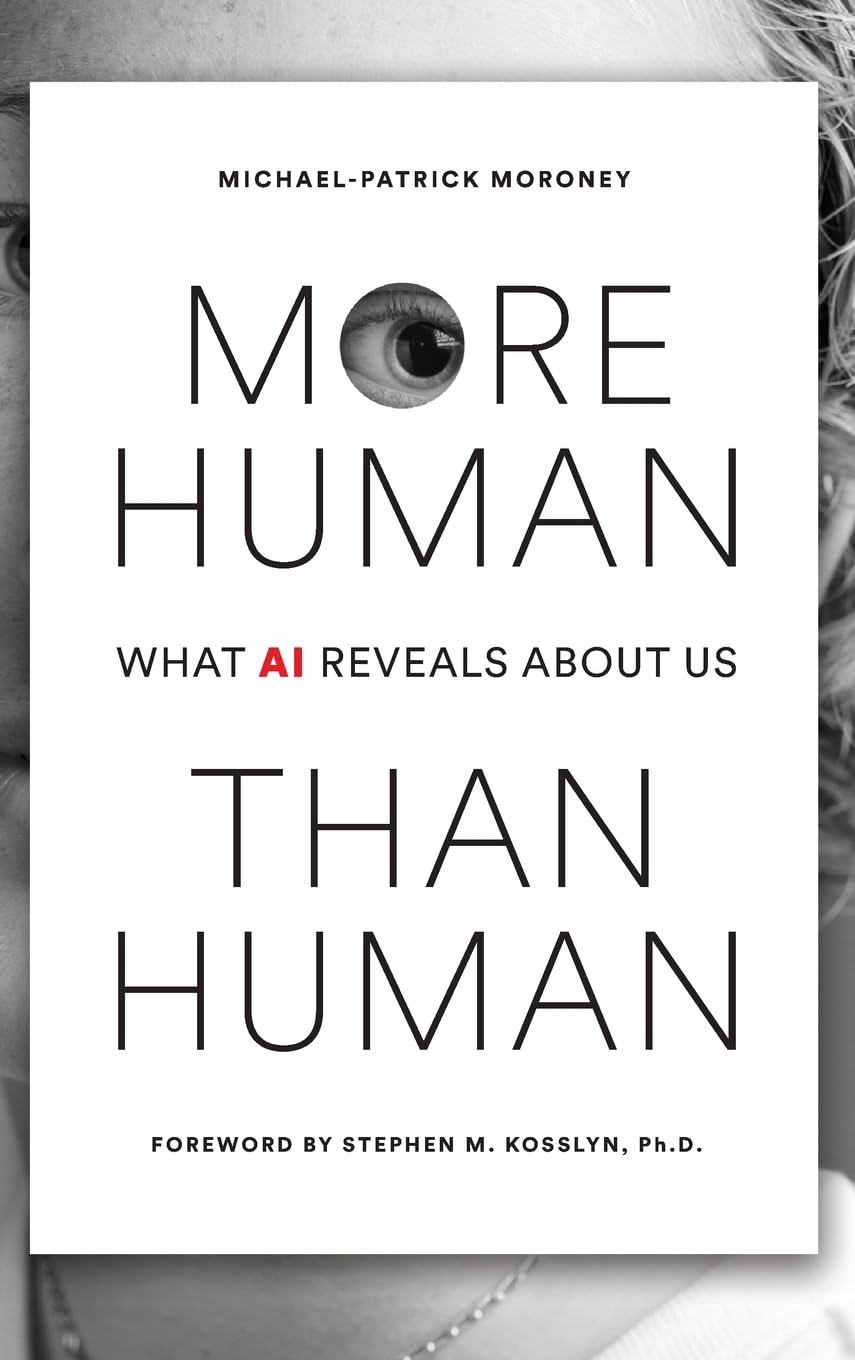
More Human Than Human
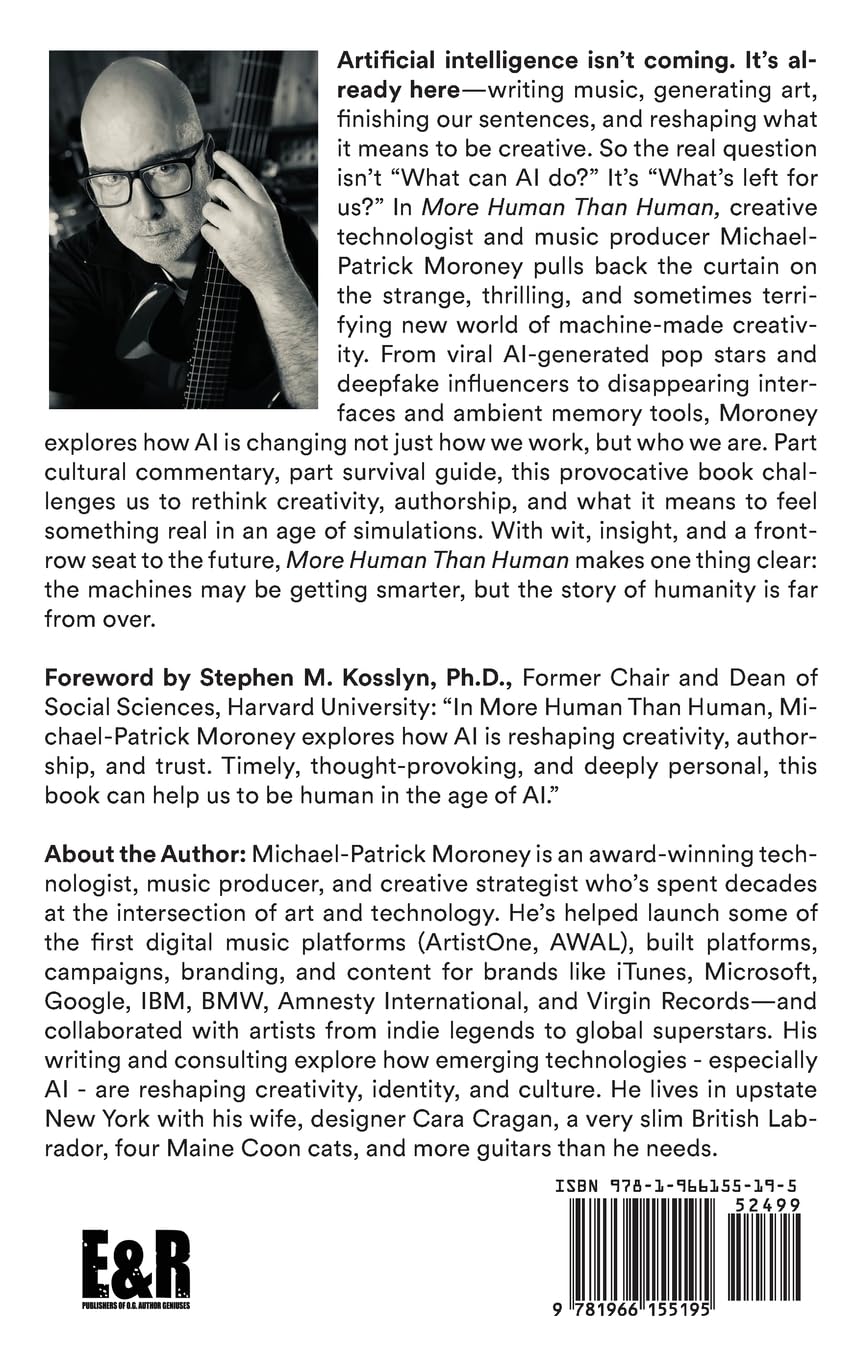
About More Human Than Human

Micheal-Patrick Moroney
Author of More Human Than Human Warns: Today’s Trillion-Dollar AI Boom Risks Locking In a “Dial-Up Era”—and Creative Friction Is the Way Out
“The best machines don’t replace creativity, they provoke it.”
”
NEW YORK, NY, UNITED STATES, January 7, 2026 /EINPresswire.com/ -- As artificial intelligence becomes faster, more fluent, and more embedded in everyday life, creative technologist and author Michael-Patrick Moroney is offering a measured but urgent cultural warning: the greatest risk of the AI era is not machine dominance, but human disengagement.— Michael Moroney
Foreword by: – Stephen M. Kosslyn, Ph.D. Cognitive Neuroscientist and Dean of Social Science, Harvard University.
"We are living in a time when the boundary between mind and machine is no longer theoretical—it is experiential. Every day, millions of people interact with systems that predict, persuade, and create. Yet, as artificial intelligence (AI) becomes more powerful, the most urgent question may not be what machines can do, but what they reveal about us in the process."
In his newly released book, More Human Than Human, Moroney explores what artificial intelligence reveals about creativity, authorship, and meaning at a moment when machines can generate convincing art, music, writing, and conversation at scale. Rather than framing AI as an existential threat or a technological miracle, the book asks a quieter—and more difficult—question: what happens to human creativity when friction disappears?
“The danger isn’t that machines are becoming more human,” Moroney says. “It’s that we’re starting to forget what being human requires—struggle, intention, taste, and presence.”
Why This Moment Matters
AI adoption has accelerated faster than any prior consumer technology. Generative systems now draft emails, compose music, design images, summarize meetings, and simulate conversation with startling ease. As fluency improves, the tools fade into the background—efficient, responsive, and increasingly invisible.
Moroney argues that this very smoothness should give us pause.
“We tend to assume that when something sounds right, it must be right,” he says. “But fluency isn’t the same as understanding. Speed isn’t the same as meaning.”
Rather than focusing on technical failure or speculative catastrophe, More Human Than Human examines a subtler cultural shift already underway: the gradual erosion of authorship, effort, and shared creative experience.
The ‘Dial-Up’ Mistake — Reframed
Moroney has described today’s AI moment as a kind of “Dial-Up era”—not as an insult, but as a historical pattern.
“Every major technology feels finished at first,” he explains. “Early systems seem miraculous. Only later do we realize they were provisional.”
In previous eras, early infrastructure reflected temporary assumptions about how people would use technology. Over time, those assumptions were overturned not by engineers alone, but by users—especially artists and creatives—who pushed tools beyond their intended purpose.
The risk today, Moroney suggests, is not that AI is underpowered, but that we mistake its current fluency for its final form—and optimize our culture around that assumption.
Creativity Has Always Driven Technology Forward
Drawing on decades of experience in music, design, and creative technology, Moroney traces a recurring historical pattern: tools evolve most dramatically when creatives misuse them.
From early digital music systems to sampling, synthesizers, and networked media, breakthroughs rarely came from frictionless efficiency. They emerged from experimentation, error, and resistance.
“The best machines don’t replace creativity,” Moroney writes. “They provoke it.”
In More Human Than Human, artists are not portrayed as victims of automation, but as the essential force that gives technology direction, texture, and meaning.
Creative Friction as Cultural Signal
A central theme of the book is what Moroney calls creative friction—the productive tension that arises when a human struggles to express something that cannot be easily optimized.
Friction, he argues, is not a bug. It is a signal.
A voice that cracks.
A performance that risks failure.
A work that bears the marks of choice and hesitation.
In an environment saturated with smooth, instantly generated content, these imperfections become not liabilities, but indicators of presence.
“As automation removes effort, effort becomes expressive,” Moroney says. “You can feel when something was risked.”
AI and the Quiet Loss of Shared Culture
The book also explores how AI-driven personalization may fragment collective experience. When content is endlessly tailored—songs generated for one listener, stories written for one mood—the shared reference points that once bound audiences together begin to dissolve.
“Culture isn’t just what gets made,” Moroney notes. “It’s what we recognize together.”
Without shared songs, stories, or moments, creativity risks becoming solitary rather than communal—a shift with social consequences far beyond the arts.
Not Replacement, But Responsibility
More Human Than Human resists both panic and nostalgia. Moroney does not argue for rejecting AI, nor does he romanticize pre-digital creation. Instead, he calls for intentional engagement.
AI, he suggests, is not an oracle to be obeyed, nor a threat to be avoided, but a collaborator that reflects our values back to us.
“These systems don’t decide what matters,” he says. “We do. And if we stop choosing—if we hand that responsibility over—we shouldn’t be surprised by what we lose.”
What the Book Offers
Rather than predictions or prescriptions, More Human Than Human offers a cultural map of the present moment—one grounded in music, art, interface design, and lived creative practice.
The book examines:
Why imperfection is becoming more valuable in an age of simulation
How authorship changes when machines can perform
What happens to trust, memory, and presence when tools become companions
Why meaning still requires a human hand in the loop
“The future isn’t robotic,” Moroney concludes. “It’s responsive. And whether it remains meaningful depends on how willing we are to stay involved.”
About the Book
More Human Than Human: What AI Reveals About Us is a collection of essays exploring creativity, technology, and human identity at a time of accelerating automation. It challenges the myth of replacement and argues for a future shaped by intention, collaboration, and cultural responsibility.
About the Author
Michael-Patrick Moroney is a creative technologist, writer, and longtime collaborator with artists, designers, and global brands. His work focuses on the intersection of creativity, culture, and emerging technology.
Simon Mills
E&R Publishers New York
+1 9177331427
email us here
Visit us on social media:
LinkedIn
Instagram
Facebook
TikTok
Legal Disclaimer:
EIN Presswire provides this news content "as is" without warranty of any kind. We do not accept any responsibility or liability for the accuracy, content, images, videos, licenses, completeness, legality, or reliability of the information contained in this article. If you have any complaints or copyright issues related to this article, kindly contact the author above.
