

Global Terahertz Imaging Detection Market Revenue to Hit US$951.95 Million by 2032
Terahertz Imaging Detection Market

QY Research, INC.
Terahertz Imaging Detection Market Report 2026–2032: market size to reach US$951.95 million by 2032 at 13.79% CAGR.
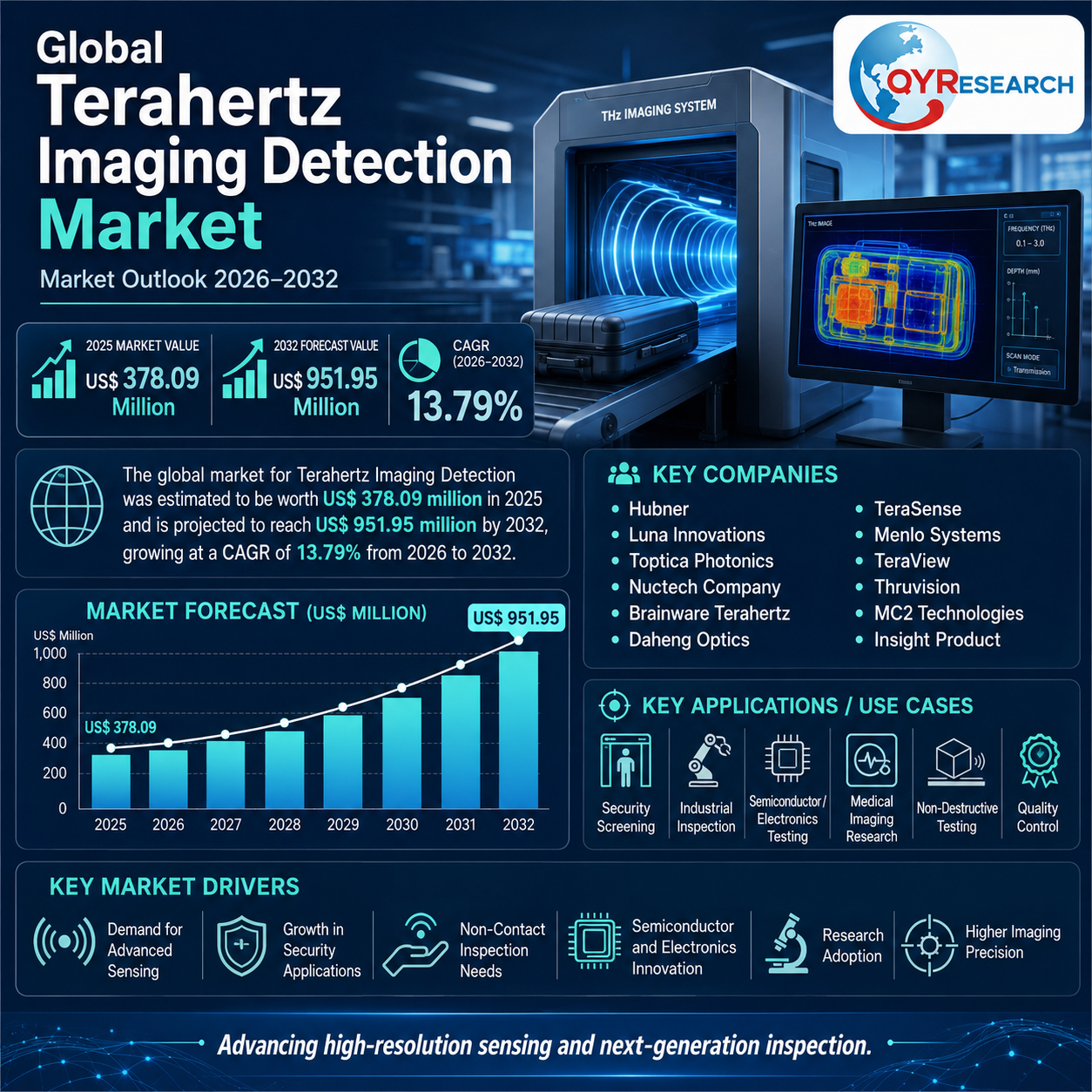
PUNE, MAHARASHTRA, INDIA, July 14, 2026 /EINPresswire.com/ -- Pune, India — The global Terahertz Imaging Detection market was estimated to be worth US$378.09 million in 2025 and is projected to reach US$951.95 million by 2032, expanding at a CAGR of 13.79% during the forecast period 2026–2032.Terahertz Imaging Detection refers to imaging and detection systems that use terahertz radiation to inspect objects, materials, structures, and biological samples without relying on ionizing radiation. Terahertz waves occupy the electromagnetic spectrum between microwave and infrared bands and are valued for their ability to penetrate many non-metallic materials, detect concealed objects, analyze material properties, and support non-destructive evaluation.
The technology is gaining importance in transportation and public safety, industrial applications, pharmaceutical and biomedical fields, advanced materials research, security screening, and quality inspection.
Download Exclusive Research Report PDF Sample: (Including Full TOC, List of Tables & Figures, Chart) @ https://www.qyresearch.in/request-sample/medical-devices-consumables-global-terahertz-imaging-detection-market-share-and-ranking-overall-sales-and-demand-forecast-2026-2032
Market Overview
The Terahertz Imaging Detection market is expected to record strong growth through 2032 as industries increasingly adopt advanced inspection and detection technologies that provide high sensitivity, non-contact measurement, and non-destructive analysis.
The report provides a comprehensive view of the global market, covering sales volume, sales revenue, pricing, market share, company ranking, regional analysis, product type segmentation, and application analysis. Market size estimates and forecasts are presented in terms of sales volume in units and revenue in US$ millions, with 2025 as the base year and historical and forecast data from 2021 to 2032.
Demand is being supported by the need for safer security inspection, improved industrial quality control, better pharmaceutical process validation, and advanced biomedical imaging research. As terahertz systems become more compact, faster, and easier to integrate, their commercial use is expected to expand across multiple sectors.
Market Key Drivers
One of the key drivers of the Terahertz Imaging Detection market is rising demand for non-destructive testing and inspection. Terahertz imaging can detect internal defects, material layers, coatings, voids, cracks, and structural changes in certain non-metallic materials without damaging the sample.
Transportation and public safety applications are also supporting market growth. Terahertz imaging can be used for detecting concealed objects, screening packages, inspecting non-metallic materials, and strengthening security operations in airports, public venues, transit systems, and border inspection environments.
Industrial demand is increasing as manufacturers seek advanced tools for quality control, process monitoring, and material inspection. Terahertz imaging is especially useful where conventional optical or X-ray methods may have limitations.
Pharmaceutical and biomedical applications are another major growth area. Terahertz systems can support tablet coating inspection, moisture analysis, material characterization, and research into biological tissues and medical imaging.
Technological progress in terahertz sources, detectors, imaging speed, data processing, and system integration is further improving market adoption.
Product Type Insights
By type, the market is segmented into Passive Terahertz Imaging and Active Terahertz Imaging.
Passive Terahertz Imaging detects naturally emitted terahertz radiation from objects or environments. It is useful in selected security, surveillance, and sensing applications where external illumination may not be required. Passive systems can provide advantages in safety, simplicity, and certain long-range detection scenarios.
Active Terahertz Imaging uses an external terahertz source to illuminate the target and capture reflected or transmitted signals. This method generally provides stronger signal control, higher imaging performance, and broader use in inspection, materials analysis, industrial quality control, and research applications.
Active terahertz imaging is expected to gain strong demand as industrial users, laboratories, and security organizations require more precise and repeatable imaging results.
Application Insights
By application, the market is segmented into Transportation and Public Safety, Industrial Applications, Pharmaceutical and Biomedical, and Others.
Transportation and Public Safety represent an important application area. Terahertz imaging can support security screening, concealed object detection, package inspection, and non-invasive scanning in transportation hubs and public infrastructure.
Industrial Applications include non-destructive testing, coating inspection, composite material analysis, semiconductor packaging inspection, plastics inspection, paper and textile analysis, aerospace materials testing, and advanced manufacturing quality control.
Pharmaceutical and Biomedical applications are gaining attention due to the ability of terahertz waves to analyze coatings, moisture content, material structure, and biological samples. Pharmaceutical companies may use terahertz imaging for tablet inspection, process control, and quality assurance.
Other applications include academic research, advanced materials development, cultural heritage inspection, environmental monitoring, defense research, and specialized scientific analysis.
Competitive Landscape
Major companies operating in the Terahertz Imaging Detection market include Hubner, Luna Innovations, Toptica Photonics, Nuctech Company, Brainware Terahertz, Daheng Optics, TeraSense, Menlo Systems, TeraView, Thruvision, MC2 Technologies, and Insight Product.
Competition is shaped by terahertz source performance, detector sensitivity, imaging resolution, scanning speed, system reliability, software capability, application-specific customization, and customer support.
Companies with strong capabilities in photonics, optics, signal processing, security inspection, industrial metrology, and scientific instrumentation are well positioned in this market. As applications diversify, suppliers are expected to compete not only on hardware performance but also on software analytics, imaging algorithms, system integration, and industry-specific solutions.
Future competition is likely to move toward compact systems, faster imaging platforms, lower-cost devices, AI-assisted image interpretation, and integrated inspection solutions.
Regional Market Outlook
North America is expected to remain an important market due to strong demand from defense, public safety, industrial R&D, pharmaceutical research, biomedical studies, and advanced manufacturing.
Europe is supported by photonics research, industrial quality inspection, pharmaceutical manufacturing, public safety applications, and strong academic and scientific instrumentation ecosystems.
Asia-Pacific is expected to offer strong growth opportunities due to expanding industrial manufacturing, security infrastructure investment, pharmaceutical production, electronics manufacturing, and research activity. China, Japan, South Korea, and other regional markets are expected to play important roles.
Other regions may see gradual adoption as transportation security, industrial inspection, and research infrastructure develop.
Industrial Chain Analysis
The upstream industry includes terahertz sources, photoconductive antennas, lasers, detectors, sensors, optical components, lenses, mirrors, signal processing chips, electronic modules, mechanical scanning components, and imaging software tools.
Midstream companies design and manufacture terahertz imaging systems, detection modules, security inspection systems, industrial testing platforms, laboratory instruments, and customized imaging solutions.
Downstream customers include transportation security agencies, public safety departments, industrial manufacturers, pharmaceutical companies, biomedical research institutions, universities, government laboratories, defense organizations, and advanced materials companies.
Key value is concentrated in terahertz generation, detector sensitivity, optical design, imaging algorithms, signal processing, system calibration, software analytics, and application-specific integration.
Market Challenges
The Terahertz Imaging Detection market faces challenges related to system cost, technical complexity, limited awareness in some industries, and application-specific performance requirements.
Compared with mature inspection technologies, terahertz imaging systems may require higher upfront investment and specialized technical knowledge. This can slow adoption among cost-sensitive users.
Performance can also vary depending on material type, sample thickness, moisture content, scanning conditions, and system configuration. Suppliers must provide strong application support to help customers validate performance.
Another challenge is the need for faster imaging speed and improved system portability. As users demand real-time inspection and field deployment, manufacturers must continue improving system design, automation, and software processing.
Development Opportunities
The market presents strong opportunities in transportation security and public safety. As security threats become more complex, non-invasive and non-ionizing inspection technologies are gaining attention.
Industrial non-destructive testing is another major opportunity. Terahertz imaging can support quality inspection in composites, coatings, plastics, electronics, packaging, and advanced materials.
Pharmaceutical quality control offers significant potential. Tablet coating analysis, moisture detection, and process monitoring can benefit from terahertz imaging because it provides non-destructive internal and surface information.
Biomedical research and medical imaging may create long-term opportunities as terahertz technology advances in sensitivity, resolution, and interpretation.
AI-assisted terahertz image analysis could also become an important development direction, helping users detect defects, classify materials, and interpret imaging results more efficiently.
Outlook 2026–2032
The outlook for the global Terahertz Imaging Detection market remains strong. The market was estimated at US$378.09 million in 2025 and is projected to reach US$951.95 million by 2032, growing at a CAGR of 13.79% during 2026–2032.
For investors, the market offers exposure to a high-growth advanced imaging and detection technology segment linked to public safety, industrial inspection, pharmaceutical quality control, biomedical research, and non-destructive testing. For manufacturers, future competitiveness will depend on imaging resolution, detector sensitivity, system cost, software capability, scanning speed, customization, and application support.
As industries increasingly demand safer, faster, and more precise inspection technologies, Terahertz Imaging Detection is expected to become an important tool in advanced sensing and imaging. Companies that can deliver reliable, compact, high-performance, and application-ready terahertz imaging solutions will be well positioned to capture growth opportunities during the forecast period.
Explore Full Report With Detailed TOC Here @ https://www.qyresearch.in/report-details/7698135/Global-Terahertz-Imaging-Detection-Market
About QYResearch
QYResearch is a global market research and consulting company founded in California, USA in 2007. With over 17 years of experience and professional research teams in various cities around the world, QYResearch focuses on management consulting, database and seminar services, IPO consulting, industry chain research, and customized research. QYResearch data is widely cited in prospectuses, annual reports, and presentations. The company helps clients understand market opportunities, evaluate industry chains, support strategic decisions, and build sustainable growth models. Up to now, QYResearch has cooperated with more than 60,000 clients across five continents.
Contact US
Ankit Jain - Director, Global Digital Marketing
QY Research, INC.
India Office -
315Work Avenue, Raheja Woods, Kalyani Nagar,
Pune, Maharashtra 411006, India
Web – https://www.qyresearch.in
Email- ankit@qyresearch.com
Ankit Jain
QY Research India
+ +91 8149736330
ankit@qyresearch.com
Legal Disclaimer:
EIN Presswire provides this news content "as is" without warranty of any kind. We do not accept any responsibility or liability for the accuracy, content, images, videos, licenses, completeness, legality, or reliability of the information contained in this article. If you have any complaints or copyright issues related to this article, kindly contact the author above.
