

Every Age, Every Stage: Where Cape Cod Stands This National Immunization Awareness Month
Published on: August 4, 2026

By Marina Tonial, MPH, CHES®, Community Health Educator, and Cassidy O’Hara, MPH, Epidemiologist
Every August, National Immunization Awareness Month arrives at exactly the right moment. Back-to-school forms are piling up, fall respiratory season is around the corner, and it’s the natural time of year to ask a question most of us don’t think about often enough: is everyone in my household actually up to date?
Not just the kids heading into kindergarten. The college student. The grandparent. You.
The National Picture Has Changed
Measles was declared eliminated in the United States in 2000 — meaning the virus was no longer spreading continuously within the country. That status is now at serious risk.
As of July 30, 2026, the CDC had confirmed 2,371 measles cases in the United States this year — a total that has now surpassed all of 2025 and stands as the highest annual count since 1991, with five months of the year still remaining. Thirty-seven outbreaks have been reported, and cases have appeared in 45 jurisdictions. International health officials are scheduled to formally review the country’s elimination status in November.
The driver isn’t mysterious. Roughly 94% of 2026 cases have been outbreak-associated, in people who were unvaccinated or whose vaccination status was unknown. And coverage has been slipping: national MMR vaccination coverage among kindergartners fell from 95.2% in the 2019–2020 school year to 92.5% in 2024–2025, dropping below the 95% threshold generally needed for community immunity and leaving an estimated 286,000 kindergartners unprotected.
That 95% number matters more than it might seem. Measles is one of the most contagious diseases known — it spreads so efficiently that community protection requires an unusually high share of people to be immune. And statewide averages hide a lot: local clusters of unvaccinated families matter more than the state number, which is why a single case can ignite an outbreak in a community where coverage has quietly slipped.
Which brings this home to Cape Cod.
The Local Picture
Massachusetts has historically had strong school vaccination coverage. But Barnstable County’s numbers deserve a closer look.
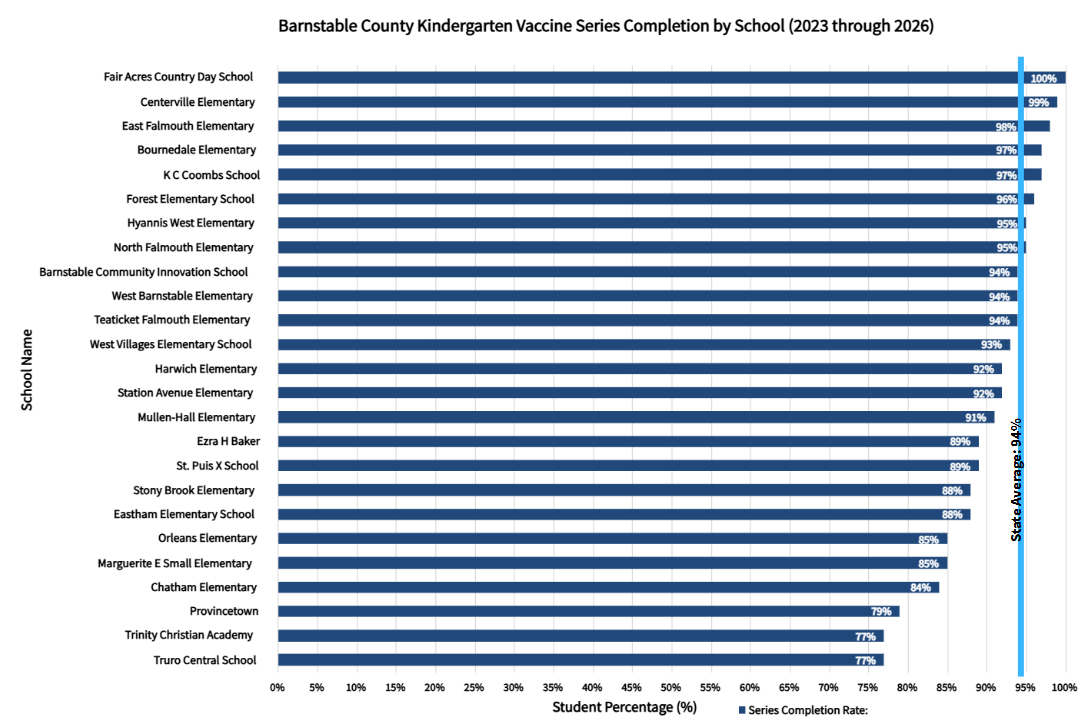
A vaccine series is the complete set of recommended doses for each vaccine needed to provide the strongest and longest-lasting protection against vaccine-preventable diseases. In Massachusetts, kindergarten students are required to have completed age-appropriate immunization series that include vaccines against diphtheria, tetanus, pertussis (DTaP), polio, measles, mumps, rubella (MMR), hepatitis B, and varicella (chickenpox), unless they have a qualifying medical or religious exemption. Completing the full series is essential because partial vaccination may not provide adequate immunity, leaving children more susceptible to infection and increasing the likelihood of disease transmission within schools and the broader community. High vaccination coverage also supports community (herd) immunity, which helps protect infants, immunocompromised individuals, and others who cannot be fully vaccinated. Maintaining high levels of school vaccination rates are critical to reducing the risk of outbreaks and protecting vulnerable populations.
Across Barnstable County, most schools reported kindergarten vaccine series completion rates that were comparable to or exceeded the Massachusetts statewide average, reflecting strong vaccination coverage in many communities. However, several schools reported lower completion rates, highlighting the need to improve vaccine compliance to maintain the high levels of coverage required to prevent the spread of vaccine-preventable diseases. Because community immunity depends on consistently high vaccination rates, even small declines in coverage can increase the likelihood of disease transmission within schools and surrounding communities. Continued progress will require collaboration among families, schools, healthcare providers, and public health agencies to promote timely vaccination and improve vaccine series completion across schools.
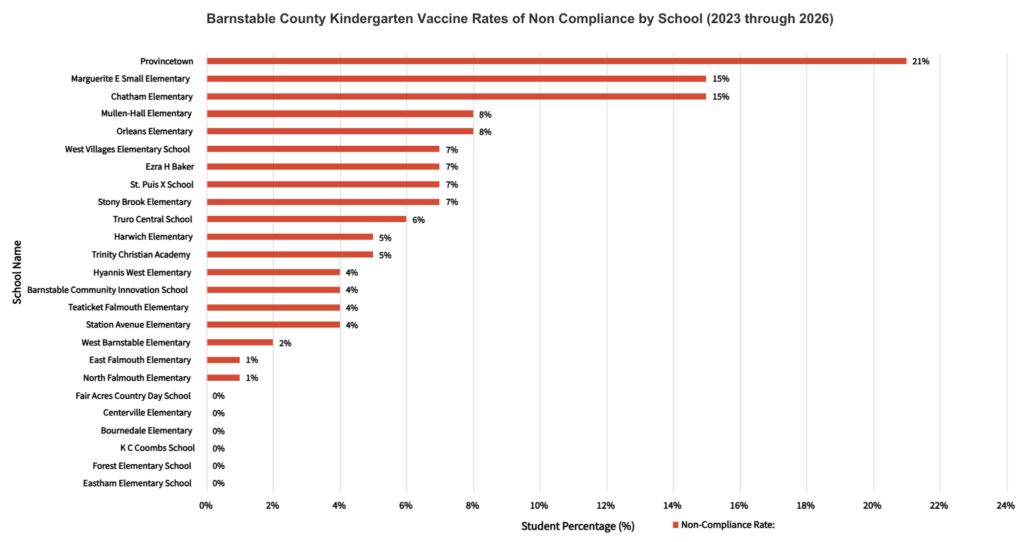
Vaccine non-compliance rates refer to the percentage of individuals who do not receive recommended vaccinations even though they do not have an approved medical or religious exemption. A medical exemption is given when a health condition makes it unsafe for a person to receive a vaccine. A religious exemption is granted when a person’s sincerely held religious beliefs prevent them from being vaccinated. Individuals without one of these approved exemptions who remain unvaccinated are considered non-compliant. High rates of vaccine non-compliance make it more difficult to maintain community immunity and increase the risk of spreading vaccine-preventable diseases. As community immunity declines, vulnerable populations face a greater risk of serious illness. In Barnstable County, vaccine non-compliance rates ranging from 0% to 21% demonstrate that some communities have substantial gaps in vaccination coverage, highlighting the potential for increased disease transmission and the importance of maintaining high vaccination rates.
A Note about the Data: To improve the reliability of school-level estimates and increase the inclusion of smaller schools, the data presented in both charts above represent a three-year average. Schools not included in the analysis either did not report vaccination data or had fewer than 30 kindergarten students, resulting in data suppression to protect student privacy and ensure stable estimates. Data Source: https://www.mass.gov/info-details/school-immunizations
A Note from a School Nurse
We asked Mary Ellen Reed, Director of Health and Wellness and School Nurse for Nauset Public Schools District, what she sees from her side of this.
“As school nurses, our daily mission is protecting the health and public safety of our entire school family. Many common illnesses are entirely preventable, but protecting our school community requires a team effort. To keep our halls safe and open, public health regulations require students who aren’t up to date on vaccines to be excluded from school during an outbreak. Staying current on scheduled vaccines is one of the best ways we can care for our neighbors and keep our kids where they belong, in school.”
— Mary Ellen Reed, School Nurse
That exclusion piece is worth underlining, because a lot of families don’t know about it until it happens to them. Under Massachusetts regulations, during an active outbreak of a vaccine-preventable disease, students who aren’t up to date on the relevant vaccine can be kept out of school — sometimes for weeks. That applies to students with exemptions on file as well. It’s not a punishment; it’s how schools contain diseases. But it means an incomplete record can turn into missed classroom time very quickly.
What’s Required for School in Massachusetts
Massachusetts school immunization requirements are established under 105 CMR 220.000, and they apply to all students in every grade — including students over 18 and students visiting as part of an exchange program.
Vaccine Key:
| Abbreviation | Full Name | Protects Against |
| DTaP | Diphtheria, Tetanus & Pertussis | Diphtheria, tetanus (lockjaw), whooping cough |
| Tdap | Tetanus, Diphtheria & Pertussis Booster | Booster for tetanus, diphtheria, and whooping cough |
| IPV (Polio) | Inactivated Poliovirus Vaccine | Polio |
| MMR | Measles, Mumps & Rubella | Measles, mumps, and rubella |
| Hepatitis B | Hepatitis B Vaccine | Hepatitis B virus |
| Varicella | Varicella Vaccine | Chickenpox |
| MenACWY | Meningococcal Conjugate Vaccine | Meningococcal disease (serogroups A, C, W, and Y), including meningitis and bloodstream infections |
Requirements vary by grade level, but the checkpoints families should have on their radar:
| School Entry Level | DTaP | Polio | MMR | Hep B | Varicella | Tdap | MenACWY |
| Kindergarten | 5 | 4 | 2 | 3 | 2 | — | — |
| 7th Grade | — | — | 2 | 3 | 2 | 1 | 1 |
| 12th Grade | — | — | 2 | 3 | 2 | 1 | 1 |
| College | — | — | 2 | 3 | 2 | 1 | — |
The full 2026–2027 requirements are published by the Massachusetts Department of Public Health Immunization Division and are available at mass.gov/info-details/school-immunizations.
Where to find your records: Massachusetts residents can request their own or their child’s immunization record through the Massachusetts Immunization Information System (MIIS) here: Access My Immunization Records – Massachusetts. If you’ve moved, changed pediatricians, or aren’t sure what’s on file, requesting the record before the school year starts is far less stressful than sorting it out in September.
Vaccines Across the Lifespan
Immunization gets framed as a childhood issue, but the recommended schedule runs from infancy through advanced age — and adults are where the biggest gaps usually are.
Infants and young children: Routine childhood immunization protects against 14 diseases before a child’s second birthday. On-time vaccination matters here, since the schedule is built around when infants are most vulnerable and when their immune systems respond best.
Adolescents: The pre-teen visit typically covers Tdap, meningococcal, and HPV vaccines. The HPV vaccine is worth particular attention — HPV causes roughly 27,000 cancer cases a year in the U.S., and two doses given at ages 11 and 12 provide long-lasting protection. It’s one of only a small number of vaccines that directly prevent cancer.
Adults: This is the most neglected group. Tdap boosters are recommended every ten years. Annual flu vaccination is recommended for nearly everyone. Depending on age and health status, adults may also need shingles, pneumococcal, RSV, or hepatitis vaccines. An estimated 40,000 to 50,000 U.S. adults die each year from vaccine-preventable infections or their complications.
During pregnancy. Vaccination during pregnancy protects both the pregnant person and the newborn during the months before the baby can be vaccinated directly. Changes to the immune system, heart, and lungs during pregnancy make flu more dangerous, which is why flu vaccination is specifically recommended. Tdap during pregnancy is also recommended to protect infants from whooping cough.
Older adults. Immune response weakens with age, which makes flu, pneumococcal, RSV, and shingles vaccines especially important — as well as staying current on COVID-19 vaccination based on the latest guidance.
What You Can Do This Month
Pull the records. Before the school year starts, not during it. Request through MIIS or ask your provider’s office. Access My Immunization Records – Massachusetts
Book the back-to-school physical now. Massachusetts requires a physical exam and immunization certificate before entry into kindergarten and grades 1, 4, 7, and 11. Late August appointments fill up.
Ask about your own. When you take your child in, ask what you are due for. Most adults are behind on at least one thing.
Check on the college student. Meningococcal requirements catch a lot of families off guard, and the deadline is enrollment, not orientation.
Plan for flu season. Flu vaccination typically becomes available in late summer and early fall. September and October are ideal timing for most people.
Ask your questions out loud. If you have concerns or you’re unsure about something you’ve read, bring it to a provider you trust. A real conversation beats a search engine.
The Bottom Line
Vaccination is one of the few things in public health where the individual benefit and the community benefit point in the same direction. Getting your family up to date protects them — and it protects the infant too young to be vaccinated, the classmate in cancer treatment, the neighbor with a compromised immune system.
Questions about immunization requirements or where to get vaccinated on Cape Cod? Contact the Barnstable County Department of Health & Environment’s Public Health Nursing Division at 508-375-6617 or speak with your healthcare provider.
Sources
- Centers for Disease Control and Prevention. Measles Cases and Outbreaks (updated July 23, 2026). https://www.cdc.gov/measles/data-research/index.html
- Centers for Disease Control and Prevention. National Immunization Awareness Month. https://www.cdc.gov/vaccines/events/niam/index.html
- Massachusetts Department of Public Health. School Immunizations — including 2025–2026 School Immunization Survey exemption data by county. https://www.mass.gov/info-details/school-immunizations
- Massachusetts Department of Public Health, Immunization Division. 2026–2027 Massachusetts School Immunization Requirements (updated January 2026). https://www.mass.gov/doc/immunization-requirements-for-school-entry-updated-21226/download
- Massachusetts Department of Public Health. Information About Meningococcal Disease, Vaccines, Vaccination Requirements and the Waiver, 2026–2027. https://www.mass.gov/doc/information-about-meningococcal-disease-meningococcal-vaccines-vaccination-requirements-and-the-waiver-for-students-at-colleges-and-residential-schools-0/download
- U.S. News & World Report (July 2026). Tracking U.S. Measles 2026. https://www.usnews.com/news/health-news/articles/tracking-the-2026-u-s-measles-outbreaks
- American Lung Association. National Immunization Awareness Month. https://www.lung.org/media/press-releases/national-immunization-1
Legal Disclaimer:
EIN Presswire provides this news content "as is" without warranty of any kind. We do not accept any responsibility or liability for the accuracy, content, images, videos, licenses, completeness, legality, or reliability of the information contained in this article. If you have any complaints or copyright issues related to this article, kindly contact the author above.
